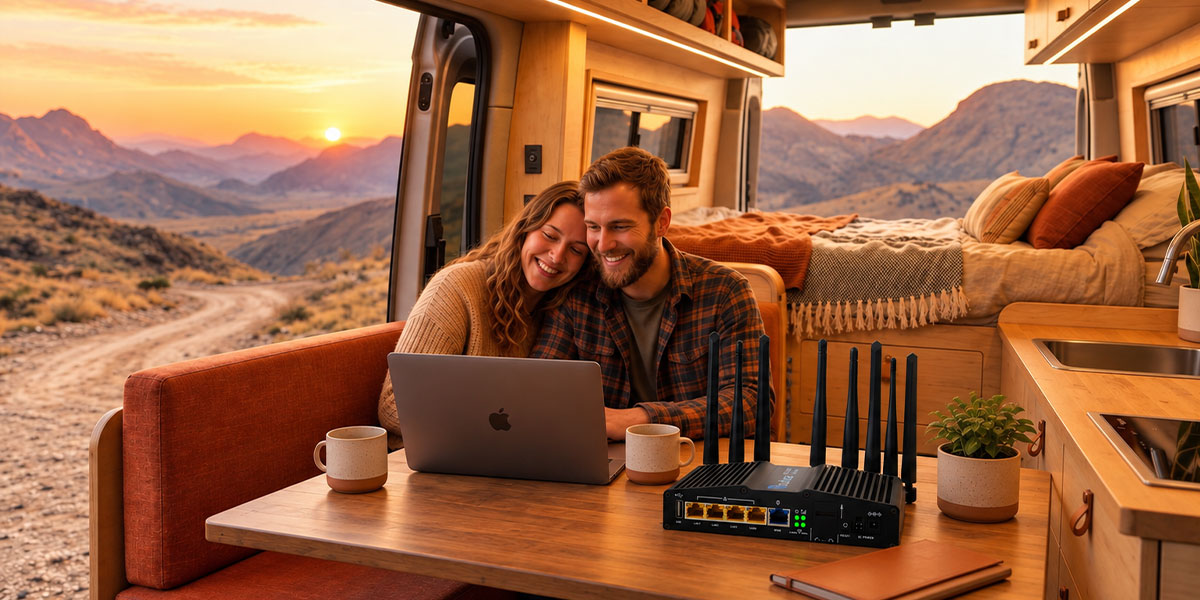


Your phone’s hotspot works perfectly during a weekend getaway. But what happens when you’re travelling for weeks, working remotely, or connecting several devices at once?
That’s when many RV travellers start considering a dedicated RV router.
But is it really worth the investment?

A dedicated RV router can be worthwhile for frequent travellers, remote workers, and families using multiple connected devices. Compared with relying solely on a phone hotspot, it can provide a dedicated local network, more connection options, and features such as WAN failover. The right choice depends on your travel habits, coverage, and budget.
1. Phone Hotspot vs. Dedicated RV Router: What’s the Difference?
A smartphone hotspot is convenient. It requires little additional equipment and may be sufficient for occasional internet access.
However, using your phone as the main connection for an entire RV can become inconvenient when multiple people need internet simultaneously.
A dedicated RV router creates a Wi-Fi network specifically for your RV’s devices. Depending on the model, it may also support external antennas, multiple WAN sources, and advanced network settings.
Phone Hotspot vs. Routica Explorer Wireless Gateway Router
| Feature / Benefit | Phone Hotspot | Routica Explorer Wireless Gateway Router |
|---|---|---|
| Dedicated RV Wi-Fi network | Depends on your phone’s hotspot | Dedicated Wi-Fi network for your RV devices |
| Multiple connected devices | Limited by phone capabilities | Designed to connect multiple devices through one network |
| Cellular connectivity | Uses the phone’s cellular connection | Dedicated 4G LTE/LTE-A or 5G options, depending on model |
| External antenna support | Generally not available | Compatible indoor and outdoor antenna options |
| Campground Wi-Fi sharing | Generally limited | Wi-Fi as WAN shares campground Wi-Fi across RV devices |
| Automatic internet failover | Generally unavailable | Switches to another configured, available WAN source when failure conditions are met |
| Multiple cellular carrier options | Depends on phone and SIM support | Explorer II supports dual physical SIM slots and eSIM profiles, with manual switching |
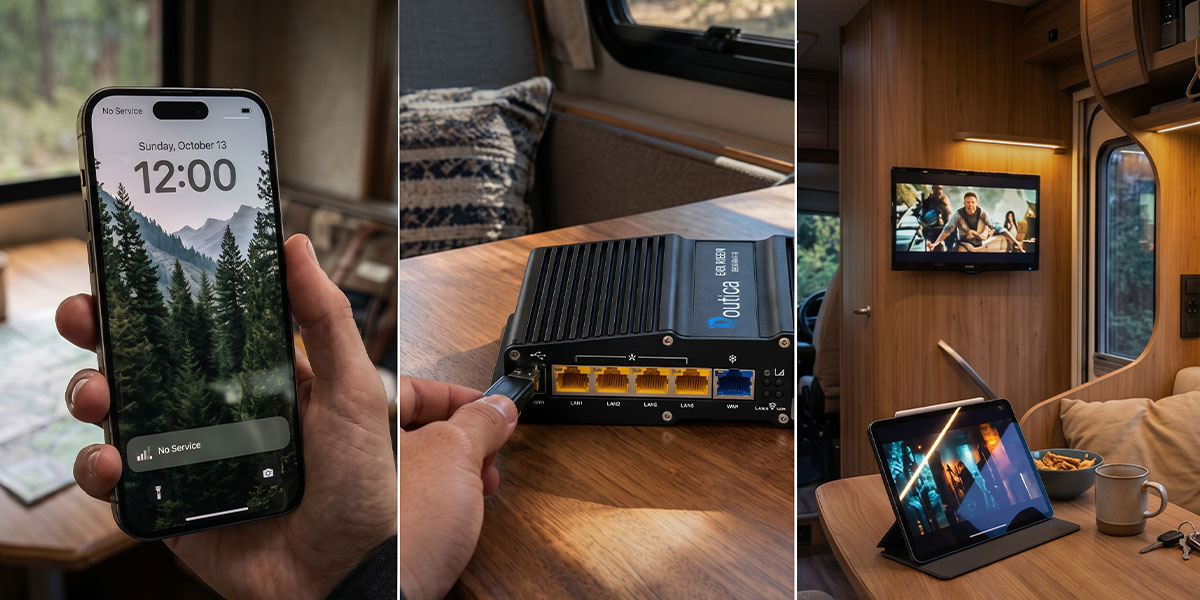
| Offline entertainment | Requires separately stored media and compatible apps | USB Media Server streams compatible saved media over local Wi-Fi without internet |
2. When Does a Dedicated RV Router Make Sense?
You Travel Frequently
If you’re on the road regularly, reconnecting devices to different networks can become frustrating. A dedicated RV router lets your devices stay connected to the same local Wi-Fi network while you change the underlying internet source.
You Work Remotely
Video meetings, cloud applications, and online collaboration require a dependable internet plan. A router that supports multiple WAN sources can offer more flexibility when one connection becomes unavailable.

However, no router can guarantee uninterrupted internet access in areas without usable connectivity.
Your Family Uses Multiple Devices
Phones, tablets, laptops, and smart TVs can all share one RV network.
A dedicated router provides a central place to manage those connections instead of depending entirely on one person’s phone. It is most useful when connectivity is part of your everyday travel routine, not just an occasional convenience.

3. Features Worth Looking for Before Buying
Not every RV router offers the same capabilities.
When comparing models, consider the following:
- Cellular network support: Choose a router compatible with the cellular networks and data plans you intend to use.
- Wi-Fi as WAN: Connect to available campground Wi-Fi and share it through your RV’s network.
- Automatic WAN failover: Switch to another configured, available internet source when the active connection meets failure conditions.
- External antenna compatibility: Consider this if you regularly travel through areas with challenging reception.
- Local media sharing: Find a router that supports streaming files stored locally without using cellular data.
A dedicated RV router should match your actual travel needs rather than simply offering the longest feature list.
4. How Routica Explorer Wireless Gateway Routers Fit Different Travel Styles
Routica offers two Explorer Wireless Gateway Routers.
- Routica Explorer I supports LTE Cat 4 and Cat 6 variants, making it an option for travellers who primarily need 4G LTE connectivity.
- Routica Explorer II offers Cat 12 LTE and 5G configurations for users seeking higher theoretical cellular performance and additional connectivity options.
Both products support features designed for RV travel, including Wi-Fi as WAN, WAN failover, and USB Media Server functionality. Your actual internet speed will depend on carrier coverage, network conditions, your data plan, and your equipment setup.
5. When a Dedicated Router May Not Be Necessary
A dedicated RV router isn’t the right purchase for everyone.
If you travel only a few weekends each year, use very little data, and rarely connect more than one or two devices, your smartphone hotspot may be enough.
It’s also important to consider the additional cost of compatible cellular service. Buying more capable hardware won’t solve poor coverage or restrictive data plans.
Choose your RV internet equipment based on travel frequency, connected devices, and available networks, not advertised speeds alone.
Summing Up
A dedicated RV router is worth considering when internet access plays an important role in how you travel, work, and stay entertained. Whether you’re a weekend camper or a full-time RVer, the goal is to choose equipment that fits your connectivity needs.
Explore the Routica Explorer Wireless Gateway Router range on the Routica Online Store or browse available Routica products on Amazon.
Make your next RV adventure a little more connected.
Frequently Asked Questions
Is a dedicated RV router better than a phone hotspot?
It can be better for managing multiple devices and internet sources. For occasional light use, a phone hotspot may be sufficient.
Does an RV router need a SIM card?
Cellular RV routers generally require a compatible SIM or supported eSIM configuration and an appropriate data plan to use mobile networks.
Can an RV router work without cellular service?
Yes. Supported models can create a local Wi-Fi network and use other available internet sources, such as campground Wi-Fi or Ethernet. Local media sharing may also work without internet access.